
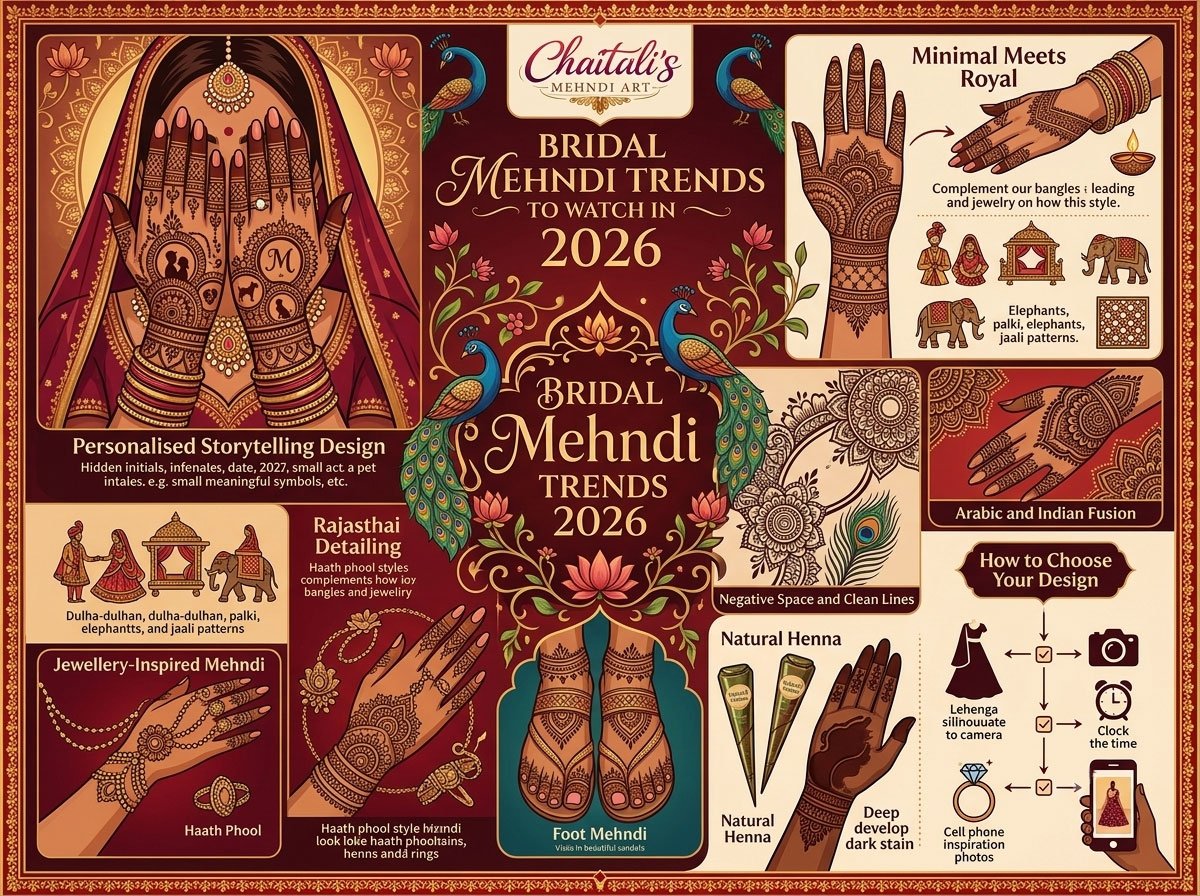
Every wedding season brings fresh ideas to the bride’s hands. In 2026, bridal mehndi is moving in a clear direction: more personal, more thoughtful, and more connected to the bride’s own story than ever before. Brides still love the deep, rich stain and the traditional motifs, but they now want designs that feel like theirs.
At Chaitali’s Mehndi Art, we speak with brides every week about what they want on their big day, and a few patterns keep coming up. In this guide, we share the bridal mehndi trends to watch in 2026, explain what each one looks like, and help you decide which suits your outfit, your ceremony and your personality.
If you would like more inspiration after reading, browse the full collection on our blog.
Table of contents
- Personalised storytelling designs
- Minimal meets royal: balanced full-hand designs
- The return of Rajasthani detailing
- Arabic and Indian fusion
- Negative space and clean-line designs
- Jewellery-inspired mehndi
- Regional and cultural motifs
- Script and calligraphy
- Foot mehndi that matches the hands
- Pre-wedding and mini-ceremony mehndi
- Natural henna and skin-friendly choices
- How to choose the right trend for you
- Frequently asked questions
1. Personalised storytelling designs
The biggest shift we see is personalisation. Instead of choosing a design purely from a photo, brides now ask for details that reflect their own journey: initials tucked into a floral vine, a wedding date hidden in a peacock’s feather, or a small motif representing how the couple met.
Traditional hidden-name and initial games are not new, but in 2026 they are becoming more creative. Brides ask for:
- Initials woven into paisleys or mandalas
- A significant date written in a small, elegant script
- Motifs from the couple’s shared hobbies or hometown
- Symbols that honour family traditions
Why it works: A personalised design turns your mehndi into a keepsake. Years later, you will look at your wedding photographs and find a small detail only you understand.
Tip: Share your ideas with your artist at the time of booking. Details that need careful placement should be planned before the session begins, not during it.
2. Minimal meets royal: balanced full-hand designs
For a while, brides felt they had to choose between very minimal and very heavy designs. In 2026, the trend is somewhere in the middle. Think of a rich, detailed palm and fingers, paired with a lighter forearm that lets your bangles, chura or sleeves shine.
This “balanced” approach works well because:
- It keeps the traditional bridal look
- It shows off jewellery and outfit embroidery
- It photographs cleanly
- It can be completed in a more comfortable amount of time
If you love bold detail but do not want the design to compete with your outfit, this style deserves a close look. Our bridal mehndi service can be tailored from light to full-coverage, depending on what you prefer.
3. The return of Rajasthani detailing
Fine-line, story-driven Rajasthani mehndi is finding new admirers. Brides are drawn to peacocks, jaali (mesh) fillings, palki scenes, elephants, arches and dulha-dulhan figures. The style feels timeless, and it looks stunning in close-up photography and videos.
What is new in 2026 is how brides are using it. Rather than filling every inch, many are choosing one or two Rajasthani focal points, such as a bridal portrait on the back of the hand or a peacock at the centre, and surrounding them with softer floral work.
To explore this style in more depth, read our guide to Rajasthani bridal mehndi patterns.
4. Arabic and Indian fusion
Fusion designs continue to grow in popularity. Arabic mehndi is known for bold outlines, flowing vines and open space, while Indian styles lean towards dense fillings and detailed motifs. Together, they create a design that feels both fresh and traditional.
A typical fusion design might have:
- A detailed Indian-style centre on the palm
- Flowing Arabic vines running up the forearm
- Bold florals with fine jaali accents
- A clean, open area near the wrist for bangles
This style suits brides who want a rich look but with room to breathe. If Arabic patterns interest you, see our post on Arabic mehndi designs for brides.
5. Negative space and clean-line designs
Negative space designs, where parts of the pattern are left unfilled so the skin becomes part of the artwork, are gaining ground. Instead of solid, heavily filled shapes, artists use outlines and gaps to create contrast and a lighter feel.
Where you will see it:
- Leaf and petal shapes with unfilled centres
- Mandalas with empty rings between filled layers
- Bold outlines with a single fine-lined accent
This trend suits brides who want something modern but still elegant, and it works particularly well for brides who prefer a less crowded look.
6. Jewellery-inspired mehndi
Jewellery-style mehndi mimics the look of bracelets, rings, chains and hand-harness pieces, often known as haath phool style. The design flows from the fingers to the wrist as if the henna itself were ornaments.
Popular elements include:
- Finger bands that look like rings
- Delicate chains connecting the fingers to the wrist
- Cuff patterns around the wrist
- Pendant-like motifs at the centre of the palm
This style is loved by brides who want a graceful look, and it pairs well with a lighter forearm. It also works nicely for engagement and sangeet functions. For event-specific ideas, see our guides on engagement ceremony mehndi and Sangeet night mehndi designs.
7. Regional and cultural motifs
Brides are increasingly proud of their roots, and their mehndi shows it. Instead of copying a generic design, they ask for motifs that reflect their own community and traditions.
Some examples:
- Gujarati brides: Garba-inspired circles, dandiya sticks, kalash, mor (peacock) and geometric patterns that echo traditional chaniya choli work
- Rajasthani brides: Palkis, havelis, camels and mor
- Punjabi brides: Bold florals, jaali, and phulkari-inspired patterns
- South Indian brides: Temple motifs, lotus and mango (kairi) patterns
If you are getting married in Ahmedabad or elsewhere in Gujarat, bringing local cultural elements into your design is a lovely way to make it truly yours.
8. Script and calligraphy
Beautiful lettering is another 2026 favourite. Brides ask for names, blessings, short verses or dates written in a decorative script and placed neatly within the design.
Popular options:
- The couple’s names in English, Hindi, Gujarati or Urdu script
- A short blessing or shloka on the wrist or forearm
- A meaningful date, written in a small, refined style
Because lettering needs precision, it is best to choose the wording and placement in advance and share them with your artist before the session.
9. Foot mehndi that matches the hands
The bride’s feet are no longer an afterthought. In 2026, many brides plan their foot design as carefully as their hands so the two look like one complete set.
Trends for feet include:
- Matching motifs, such as the same peacock or mandala on the hands and feet
- Anklet-style patterns that mimic payal
- Side-foot designs that are visible in sandals
- Jaali fillings that echo the hand design
Talk to your artist about how much of the foot and leg you would like covered. Full-leg designs take more time, so book enough hours for both hands and feet.
10. Pre-wedding and mini-ceremony mehndi
Weddings now involve more events than ever: engagement ceremonies, pre-wedding shoots, sangeet nights, court marriage registrations and festive get-togethers. Brides increasingly book mehndi for more than just the main day.
Popular options:
- Light, elegant designs for pre-wedding shoots. Read more in our guide to pre-wedding shoot mehndi.
- Simple, refined designs for court marriage ceremonies. See our post on mehndi artist for court marriage in Ahmedabad.
- Festive designs for occasions such as Diwali. Have a look at our Diwali mehndi designs.
If your dates are close together, you may also want to ask about a plan that covers all your ceremonies with designs that complement each other.
11. Natural henna and skin-friendly choices
More brides now ask what goes into their mehndi paste, and this is a healthy trend. In 2026, we expect the demand for natural henna and clear ingredient information to keep growing.
What to look for:
- Pure henna paste, without harsh additives
- Cones that are freshly prepared
- An artist who explains the ingredients and is open to questions
- A patch-test option if you have sensitive skin
Be careful about any product that promises an unusually instant, jet-black stain. Natural henna develops its colour gradually, usually a light orange at first that deepens over the next day or two.
Good preparation also makes a difference. Our guide on how to prepare your skin before a bridal mehndi session covers what to do in the days before your appointment.
12. How to choose the right trend for you
With so many options, it helps to keep a simple checklist.
1. Start with your outfit. A heavily embroidered lehenga or a chura-heavy look pairs well with a balanced design. A simpler outfit can carry a richer mehndi.
2. Think about your photographs. If you love close-up hand shots, consider a focal point such as a portrait, peacock or mandala.
3. Be realistic about time. Detailed designs on both hands and feet can take several hours. Book a slot that leaves you comfortable, not rushed. If your dates are tight, read our post on same-day mehndi booking.
4. Choose one hero element. Pick one or two main ideas and let the rest support them. Too many competing ideas can make a design feel crowded.
5. Bring references. Screenshots, colours from your outfit and a few photos of designs you like help your artist understand your taste faster.
6. Book early. Wedding season fills up quickly, so reserve your date as soon as it is confirmed.
Need more ideas? Our collection of 20 stunning bridal mehndi designs for 2026 weddings is a helpful place to start.
Tips to keep your mehndi looking its best
The right design is only part of the story. To get the deepest stain possible:
- Keep your skin clean and free of oil or lotion before the session
- Leave the paste on for as long as your artist recommends
- Keep your hands warm and avoid water for the first few hours after removal
- Follow the aftercare advice your artist gives you
Small habits make a real difference, and your artist is the best person to guide you for your skin.
What brides say
Nothing tells the story better than the brides themselves. If you would like to know what it feels like to work with us, read real brides, real stories and see why so many recommend Chaitali’s Mehndi Art to their families and friends.
Frequently asked questions
What are the top bridal mehndi trends in 2026?
The key trends are personalised storytelling, balanced designs that combine richness with open space, the return of Rajasthani detailing, Arabic and Indian fusion, negative space patterns, jewellery-inspired mehndi, regional motifs, script, matching foot designs and natural henna.
Are minimal designs still popular for brides?
Yes. Many brides choose a lighter design for certain ceremonies, and many others choose a balanced look that combines detailed hands with a simpler forearm.
How early should I book my bridal mehndi artist?
As soon as your wedding dates are confirmed. Peak wedding season fills quickly, so early booking gives you more choice of dates and time to plan your design. You can also ask about same-day mehndi booking if your plans are last-minute, though availability depends on the day.
How long does a full bridal mehndi session take?
It depends on the design. A detailed full-hand and full-leg design can take several hours, while lighter designs take less time. Your artist can give you an estimate once you decide on the design.
Can I include my partner’s name or initials in the design?
Yes. Personalised details such as names, initials and dates are a popular request. Tell your artist in advance so the placement can be planned properly.
How can I get a darker mehndi stain?
Prepare your skin well, keep the paste on for as long as your artist advises, and follow the aftercare instructions. Colour also depends on your skin and the quality of the henna.
Do you offer mehndi for events other than the wedding?
Yes. Many brides book mehndi for engagement ceremonies, sangeet, pre-wedding shoots and court marriage. Contact us to discuss a plan that suits all your events.
Book your bridal mehndi with Chaitali’s Mehndi Art
Your mehndi is one of the most personal parts of your wedding. Whether you love the fine lines of Rajasthani art, the flowing vines of Arabic designs, or a personalised design made just for you, we would love to help you create it.
At Chaitali’s Mehndi Art, we listen to your ideas, look at your outfit and ceremony plans, and design mehndi that feels like you. Visit our bridal mehndi service page to check availability, or explore more inspiration on our blog.