Diwali is the one festival that transforms an entire home — diyas lining the windowsills, rangoli patterns at the doorstep, new clothes laid out, and somewhere in the middle of all that preparation, a fresh coat of mehndi drying on outstretched hands. For most Indian women, Diwali mehndi isn’t optional. It’s part of what makes the festival feel complete.
At Chaitali’s Mehndi Art, Diwali is one of the busiest, most joyful seasons of our year. Every season, we see the same beautiful rush — mothers booking slots for the whole family, young women wanting something that photographs well for their Instagram stories, grandmothers asking for the same simple patterns they’ve worn for decades, and children eagerly waiting their turn for “just a little design” on their palms.
This guide covers everything you need to know about Diwali mehndi for the festive season — the design trends shaping this year’s requests, how to choose the right pattern for your day, application timelines, and the aftercare tips that make the difference between a mehndi stain that fades by the next morning and one that lasts through the entire festive week.
Why Mehndi Is Central to Diwali Celebrations
Mehndi has held a place in Indian festive tradition for centuries, and its association with prosperity, good fortune, and marital happiness has made it a natural companion to Diwali — the festival that celebrates the triumph of light over darkness and the arrival of abundance into the home.
But beyond the symbolism, there’s something simpler at play too. Diwali is a festival of gathering. Sisters, cousins, and friends sit together for hours, sharing design references from Pinterest and Instagram, comparing hand shapes, and turning an ordinary evening into a small celebration of its own. Mehndi application has become as much a bonding ritual as it is a beauty one.
For working professionals and homemakers alike, getting mehndi done before Diwali is also a small act of self-care in an otherwise hectic festive week filled with cleaning, cooking, and hosting.
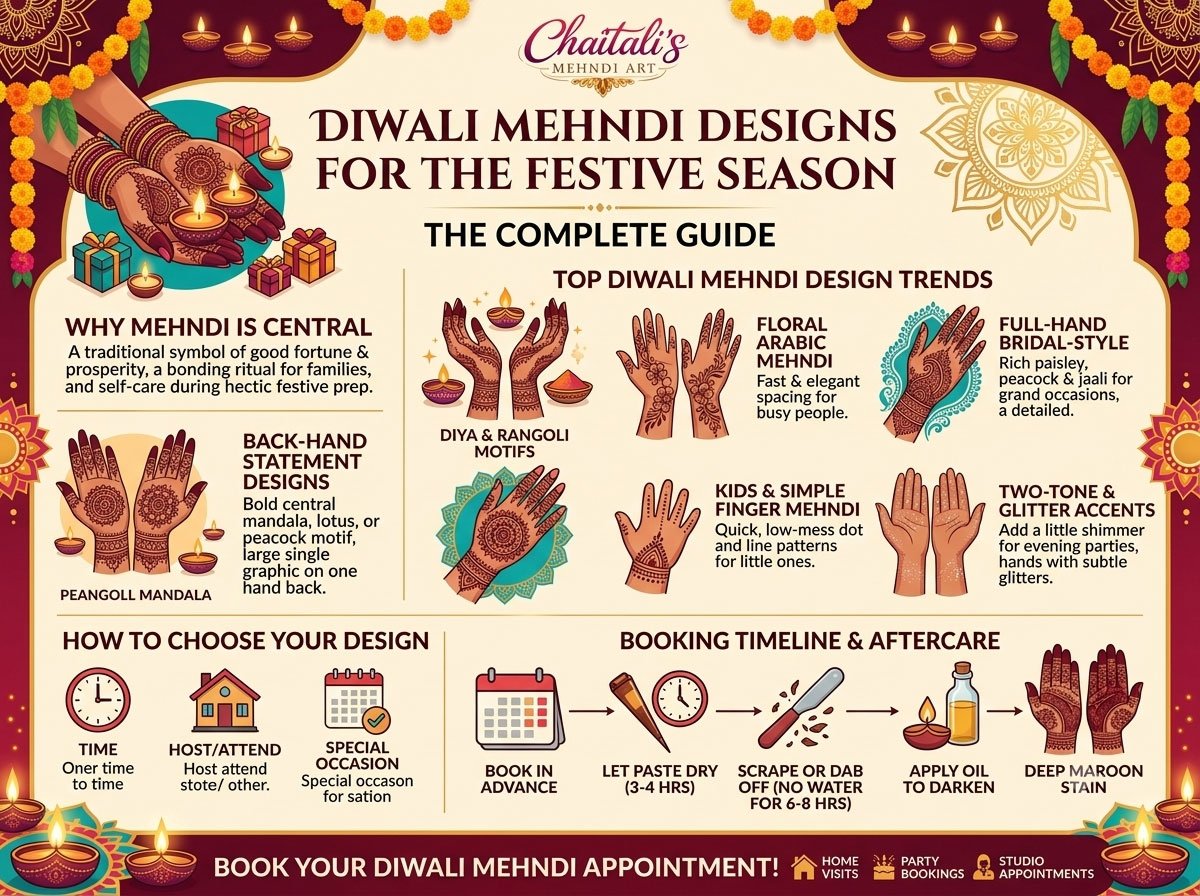
Top Diwali Mehndi Design Trends for the Festive Season
Every festive season brings its own shift in what clients are asking for. Based on what we’re seeing at Chaitali’s Mehndi Art this year, here are the design categories dominating Diwali bookings.
1. Diya and Rangoli-Inspired Motifs
It makes sense that the most iconic symbols of Diwali — the diya (oil lamp) and the rangoli — have found their way into mehndi design. Small diya outlines paired with dotted rangoli borders create a design that feels unmistakably festive without being overly heavy. These motifs work beautifully as accents on the palm, wrist, or scattered across the back of the hand.
They’re also a favorite for clients who want a design with meaning attached to it — something that visually ties back to what the festival represents.
2. Floral Arabic Mehndi
For anyone short on time during a hectic festive week, floral Arabic mehndi remains the most requested style, and for good reason. The open spacing between motifs means the design applies faster and dries quicker than a fully filled traditional pattern, while still looking rich and elegant once complete.
This style works particularly well for office-goers who need mehndi that looks festive but doesn’t interfere with typing or daily tasks the following morning.
3. Full-Hand Bridal-Style Mehndi
Diwali often overlaps with family engagements, roka ceremonies, or wedding-related functions, especially in a season when many families plan celebrations around the festival’s auspiciousness. For these occasions, a full-hand design with fine jaali (net) work, paisley motifs, and peacock detailing brings a bridal-level richness to the festive look.
This is the most time-intensive option, typically requiring 2–3 hours depending on hand coverage, and is best booked several days in advance given how quickly slots fill up during peak season.
4. Back-Hand Statement Designs
A growing number of clients are opting for a “less is more” approach — a bare or minimally decorated palm paired with one bold, detailed motif on the back of the hand. Popular choices include a large mandala, a lotus centerpiece, or a peacock design.
This style photographs exceptionally well (a real consideration now that most Diwali celebrations end up on social media) while cutting down significantly on application time compared to a full-hand design.
5. Kids’ and Simple Finger Mehndi
Diwali wouldn’t be complete without the little ones wanting mehndi too. Simple dot patterns, thin vine-like lines, and tiny floral clusters on fingers and wrists are quick to apply, low-mess, and give children the festive feeling they’re after without a lengthy sitting they’re unlikely to sit still for.
6. Two-Tone and Glitter Accent Mehndi
A smaller but growing trend this season is the use of subtle glitter or two-tone gel accents layered over a traditional henna design once it has dried. This works particularly well for evening Diwali parties, where a bit of shimmer catches the light beautifully in photographs.
How to Choose the Right Diwali Mehndi Design for You
With so many options, picking the right design comes down to matching the pattern to your actual day. A few questions worth asking yourself:
- How much time do you realistically have? If you’re juggling last-minute festival prep, choose Arabic floral or a back-hand statement design over a full bridal-style pattern.
- Are you hosting or attending? Hosts often prefer designs that stay elegant even as hands get busy through the evening — simpler patterns tend to hold up better through a night of cooking and serving.
- Is there a wedding-related event attached to this Diwali? If so, lean into a fuller, more intricate design that matches the occasion’s significance.
- How long do you need the design to last? If you want your mehndi to carry you through the entire festive week — Dhanteras through Bhai Dooj — ask your artist specifically for natural, chemical-free henna paste, which yields a deeper and longer-lasting stain than commercial cones.
Booking Timeline: When to Schedule Your Diwali Mehndi
Diwali is peak season for mehndi artists across Ahmedabad, and slots — especially on the two or three days immediately before the festival — fill up quickly. As a general guideline:
- Full-hand bridal-style designs: Book at least 1–2 weeks in advance.
- Group bookings (family or friend circles): Book at least a week ahead to secure a time window that works for everyone.
- Simple or Arabic floral designs: Can often be booked with a few days’ notice, though weekend slots close to Diwali fill up fast.
- Same-day requests: Sometimes possible for simpler designs, though availability depends heavily on how close it is to the festival. (For more detail on this, see our related post on same-day mehndi booking in Ahmedabad.)
Mehndi Aftercare: How to Get a Dark, Long-Lasting Stain
The design is only half the story — how you care for your mehndi in the hours after application makes a significant difference to the final color. Here’s the process we recommend to every client:
- Let the paste dry completely before touching anything. Ideally 3–4 hours minimum; overnight gives the richest results.
- Avoid water contact for at least 6–8 hours after the dried paste is removed. Water too soon significantly lightens the eventual stain.
- Dab off the dried paste rather than washing it. Once flakes start falling naturally, gently scrape or dab them away — don’t rinse.
- Apply a lemon-sugar mixture lightly over the design before the paste fully dries, if your artist recommends it — this helps the paste adhere longer and deepen the stain.
- Seal it with natural oil. A light coat of mustard oil, coconut oil, or eucalyptus oil once the paste is removed helps lock in and darken the color.
- Avoid soap and sanitizer directly on the mehndi area for at least the first 24 hours.
- Keep the area away from direct heat sources immediately after application, as this can cause the paste to dry unevenly.
Following this routine typically results in a stain that starts as a lighter orange and deepens to a rich maroon-brown over 24–48 hours — exactly the kind of color you want carrying you through Diwali night and the days that follow.
Why Book a Professional Mehndi Artist for Diwali
While DIY cones are widely available, festival season is when the difference between amateur and professional application becomes most visible — in symmetry, design intricacy, paste quality, and how long the stain actually lasts. A professional artist also brings the advantage of experience with festive-specific patterns like diya and rangoli motifs that can be tricky to freehand well.
At Chaitali’s Mehndi Art, we use natural, chemical-free henna paste for all our designs, ensuring a safe application and a deep, long-lasting stain — an important consideration given how often chemical-heavy commercial cones can cause skin irritation.
Book Your Diwali Mehndi with Chaitali’s Mehndi Art
Diwali is peak season, and our calendar fills up quickly as the festival approaches. Whether you need a quick festive touch-up, a group booking for the whole family, or a detailed bridal-style design for a wedding function overlapping with Diwali, Chaitali’s Mehndi Art offers home visits, party bookings, and studio appointments across Ahmedabad.
Explore related services and content: