There’s something about a perfectly symmetrical mandala that draws the eye instantly, no matter how much or how little else is happening on the rest of the hand. It’s one of the oldest, most enduring motifs in bridal mehndi, and for good reason — a well-executed mandala brings a sense of balance and precision that few other patterns can match. For brides who are naturally drawn to clean geometry and order over scattered, asymmetric detail, mandala mehndi tends to feel like an obvious choice.
If you’re considering a mandala as the centrepiece of your bridal mehndi, this guide walks through the different ways the motif can be styled, what actually goes into getting a mandala this precise, and how to plan for it as part of your overall bridal look.
Why the Mandala Endures as a Bridal Motif
The mandala’s popularity in bridal mehndi isn’t just about aesthetics, though the visual appeal is obvious. In Indian tradition, the mandala represents wholeness, balance, and the cyclical nature of life — themes that align naturally with the symbolism already built into a wedding. Placed at the centre of the palm, it becomes a kind of anchor point for the entire hand, whether the rest of the design is dense and traditional or sparse and modern.
There’s also a purely visual reason mandalas remain so popular: symmetry is inherently satisfying to look at. A mandala rewards close inspection in wedding photography in a way that asymmetric florals or scattered motifs sometimes don’t — the repeating pattern holds together as a single, cohesive shape no matter how closely the camera zooms in.
What Goes Into a Well-Executed Mandala
A mandala looks deceptively simple from a distance — just a circle, repeating outward. In practice, it’s one of the more technically demanding motifs in bridal mehndi, precisely because any small inconsistency in spacing, line thickness, or symmetry becomes immediately obvious. Unlike a floral trail or a scattered pattern, where minor imperfections blend into the overall composition, a mandala’s entire visual impact depends on precision.
Most artists work outward from a central point, using light guide marks to keep the design balanced before committing to the final linework. The number of “petals” or repeating segments, the spacing between concentric rings, and the balance between filled and open sections all have to be planned before the cone touches skin. This is part of why mandala designs, even relatively simple ones, are often best left to artists with specific experience in geometric and symmetrical work.
Mandala Mehndi Designs to Consider
1. Classic Full-Palm Mandala
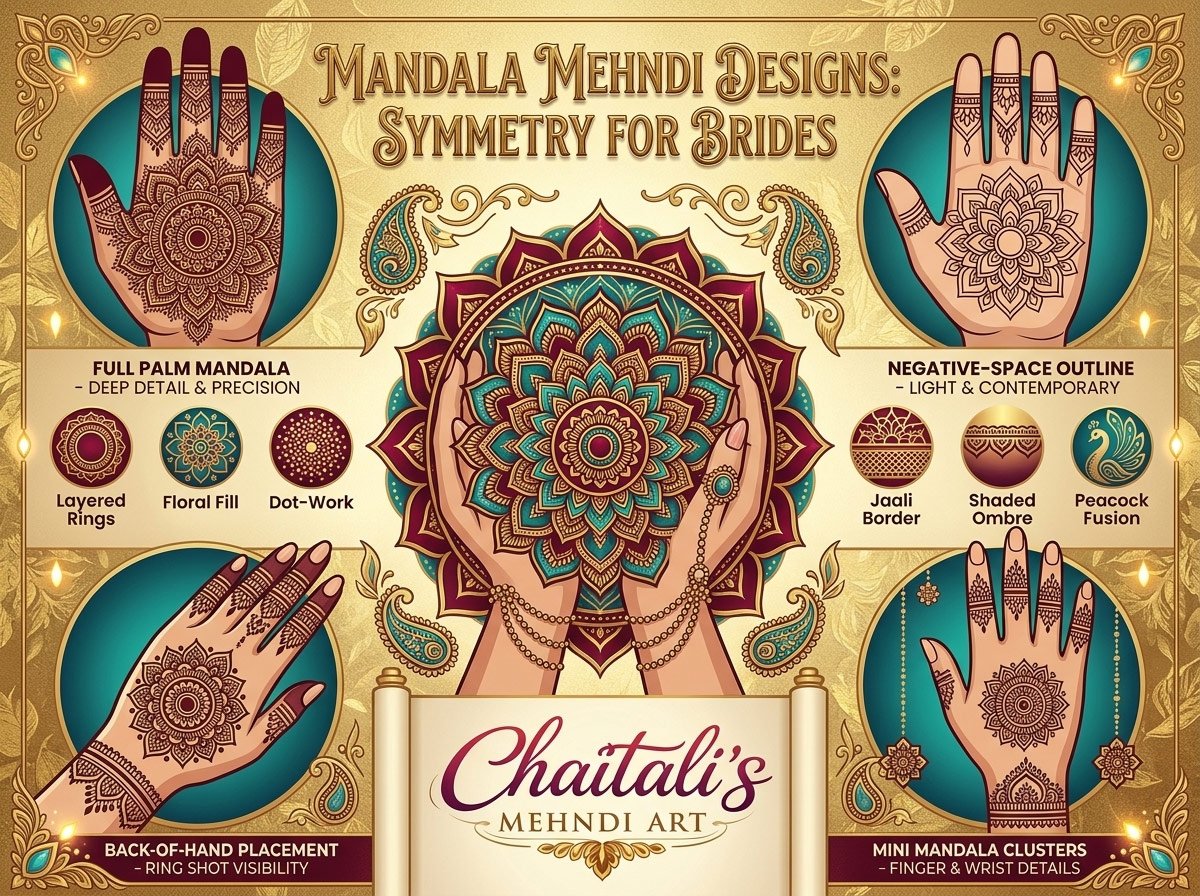
A large, densely detailed mandala filling the entire palm, with fine borders extending onto the fingers and wrist. This is the most traditional interpretation of the motif — dense, symmetrical, and unmistakably bridal, working well as a standalone centrepiece or as the anchor for a larger full-hand design.
2. Negative-Space Outline Mandala
Instead of filling the mandala completely, this version uses only outlines and selective shading, leaving significant bare skin visible within and around the shape. It keeps the geometric precision of the motif while giving the overall design a much lighter, more contemporary finish — a popular choice among brides who want the mandala’s symbolism without full palm coverage.
3. Layered Concentric Ring Mandala
Multiple rings of detail, each with a different repeating pattern, build outward from a small central point to a much larger outer border. This style rewards close-up photography especially well, since each ring reveals a different level of detail the closer you look.
4. Mandala with Radiating Floral Fill
The mandala itself stays relatively contained at the centre of the palm, while fine floral and paisley motifs radiate outward from its edges to fill the rest of the hand. This bridges traditional dense bridal mehndi with the structured precision of a mandala centrepiece, giving you both in a single cohesive design.
5. Dot-Work Mandala
Built entirely from small, precisely placed dots rather than continuous lines, this style creates a softer, more textured version of the mandala motif. It takes considerable patience and a very steady hand to execute well, since consistency across hundreds of small dots is what makes the final shape read as clean and symmetrical.
6. Back-of-Hand Mandala
Rather than the traditional palm placement, this design centres the mandala on the back of the hand instead — a placement that tends to be more visible in ring shots and candid wedding photography. It works particularly well for brides who want a mandala centrepiece but plan to keep their palms mostly bare.
7. Mini Mandala Cluster
Instead of one large mandala, this design uses several smaller mandalas scattered across the hand — one on the palm, smaller ones near the wrist or fingers — each fully symmetrical on its own but arranged asymmetrically as a group. It’s an interesting middle ground between the order of a mandala and the more relaxed feel of a scattered composition.
8. Mandala with Jaali Border
A dense, symmetrical mandala anchors the palm, framed by fine jaali (net) work extending toward the wrist and fingers. The lattice detailing complements the mandala’s geometry while adding texture and depth to the areas surrounding it, giving the overall design a more complete, layered look.
9. Shaded Ombre Mandala
Using varying cone pressure, this technique creates a gradient effect within the mandala itself — dense and dark at the centre, gradually lightening toward the outer rings. It’s a visually striking variation that requires genuine shading skill to execute evenly across a symmetrical shape.
10. Mandala and Peacock Fusion
The mandala sits at the centre of the palm while peacock motifs, a longtime favourite in bridal mehndi, extend outward from its edges toward the fingers and wrist. This combination brings together two of the most enduring bridal motifs into a single, cohesive composition.
Placement Options for a Mandala Centrepiece
Where you place your mandala changes the entire character of the design, and it’s worth thinking through deliberately rather than defaulting to the most common palm-centred placement.
Palm centre is the traditional choice, and for good reason — it’s the most visible spot when hands are held up or clasped together during ceremonies, and it photographs clearly in the classic bridal hand shots.
Back of the hand works well for brides who want the mandala visible in ring shots and candid photography, particularly if the palm itself will spend most of the day facing inward or holding a bouquet.
Wrist placement turns the mandala into something closer to a bracelet motif — smaller in scale, but still symmetrical and precise, and a good option for brides who want a mandala element without palm coverage at all.
Foot placement, usually on the top of the foot or the sole, mirrors the hand design and creates a cohesive, matched bridal look across both hands and feet.
Pairing a Mandala Design With the Rest of Your Bridal Look
Because a mandala is such a structured, symmetrical motif, it tends to pair particularly well with certain aesthetic choices elsewhere in your bridal styling.
- Structured, geometric jewellery — like a symmetrical choker or matching bangles — tends to echo the mandala’s precision rather than clash with it.
- Clean-lined outfits without too much competing embroidery let the mandala stay the clear visual focus on the hand.
- Symmetrical mandap and decor themes, common in many traditional Indian weddings, naturally tie together with a mandala-centred mehndi design for a more cohesive overall aesthetic.
- Photography that emphasises close-up hand shots benefits especially from a mandala centrepiece, since the repeating detail holds up beautifully under close inspection.
How Long Does a Mandala Design Take?
Application time depends heavily on which variation you choose. A negative-space outline mandala with minimal surrounding detail can be completed in as little as 45 minutes to an hour, making it one of the quicker bridal mehndi options available. A dense, full-palm mandala with radiating floral fill or jaali border work, on the other hand, can take 2 to 4 hours, depending on the size and how far the surrounding detail extends up the hand and arm.
If you’re combining a mandala centrepiece with a full-hand or full-arm design, budget time the same way you would for any other full-coverage bridal mehndi — several hours at minimum, with enough buffer built into your schedule that the session doesn’t feel rushed.
Tips for Planning Your Mandala Mehndi
- Decide on size before density. A mandala’s diameter has a big impact on how it reads visually — a small, precise mandala feels delicate, while a large one filling most of the palm becomes a true statement piece. Settle on scale before choosing how densely to fill it.
- Ask your artist about their geometric work specifically. Not every mehndi artist has equal experience with symmetrical, precision-heavy designs. Review portfolio examples of mandala work specifically, not just general florals, before booking.
- Think about hand position during photography. If you know your photographer plans specific hand-clasping or ring shots, mention this when planning your design so the mandala’s placement lines up with those moments.
- Consider whether you want symmetry carried through the whole hand. Some brides pair a symmetrical mandala centrepiece with an equally structured surrounding pattern, while others deliberately contrast it with looser, more organic florals elsewhere. Both work — it’s a matter of deciding which effect you want.
- Don’t rush a shaded or dot-work variation. These techniques take longer to execute evenly, so if you’re drawn to an ombre or dot-work mandala specifically, build extra time into your mehndi ceremony schedule.
Mandala Mehndi Across Different Wedding Styles
A mandala centrepiece is versatile enough to suit a range of wedding aesthetics, which is part of why it remains such a consistently popular choice.
For a traditional Indian wedding, a dense, full-palm mandala with radiating floral or jaali detailing fits naturally alongside heavier bridal jewellery and a more elaborate outfit. For a contemporary or fusion wedding, a negative-space outline mandala offers the same symbolic centrepiece with a cleaner, more modern finish that pairs well with simpler outfits and statement jewellery. For a destination wedding, a mid-sized mandala with moderate surrounding detail often strikes the right balance — substantial enough to feel bridal, without requiring the multi-hour commitment of a full traditional design.
Frequently Asked Questions
Is a mandala mehndi design suitable for a hand that isn’t perfectly proportioned? Yes. Skilled artists adjust the mandala’s size, spacing, and central point placement to suit the specific shape and size of each bride’s hand, so the design reads as symmetrical regardless of the hand’s natural proportions.
Can a mandala be combined with a hidden name or initial? Yes, though it requires careful planning. A small initial or symbol can be worked into one of the mandala’s outer sections or hidden within the surrounding fill, without disrupting the overall symmetry of the central shape.
How do I know if a mandala design will suit my outfit? Mandala designs tend to suit most bridal outfits well since the motif itself is neutral and doesn’t lean toward any particular regional style. The main consideration is scale — a large, dense mandala pairs better with a more traditional or heavily embellished outfit, while a smaller outline version suits simpler, contemporary looks.
Does a mandala design take longer than other bridal mehndi patterns? Not necessarily. A negative-space or moderately sized mandala can actually be quicker to apply than a dense floral or paisley fill covering the same amount of space, since the pattern itself is more structured and repetitive rather than requiring constant new detailing decisions.
What if I want a mandala but also want some traditional motifs like peacocks or paisleys? This is a very common request, and most artists are happy to build a design where the mandala anchors the centre while traditional motifs extend outward from its edges — giving you both the structured symmetry and the traditional detailing in one cohesive composition.
Final Thoughts
A mandala centrepiece brings a sense of order and precision to bridal mehndi that few other motifs can match, making it a natural choice for brides who are drawn to symmetry and clean geometry in every other part of their wedding planning. Whether you choose a dense, traditional full-palm mandala or a light, negative-space outline version, the motif’s enduring appeal comes from the same place it always has — the quiet satisfaction of a perfectly balanced design.
If you’re planning your wedding mehndi and want a mandala design tailored to your hand, outfit, and overall bridal look, Chaitali’s Mehndi Art offers personalised bridal mehndi consultations, engagement mehndi, and portrait mehndi services across Ahmedabad. Get in touch to start planning a mandala design that’s as balanced and precise as you imagine it.