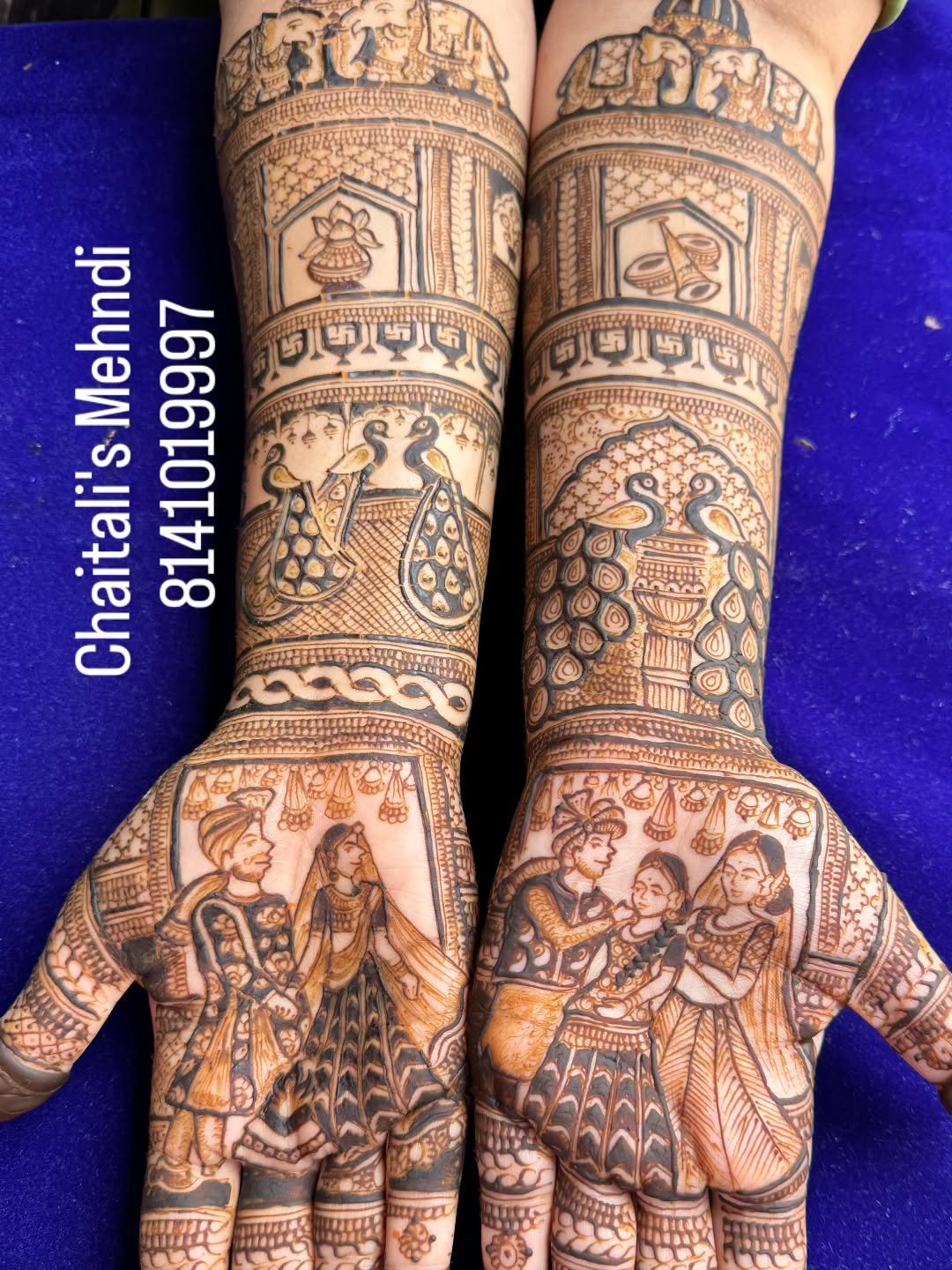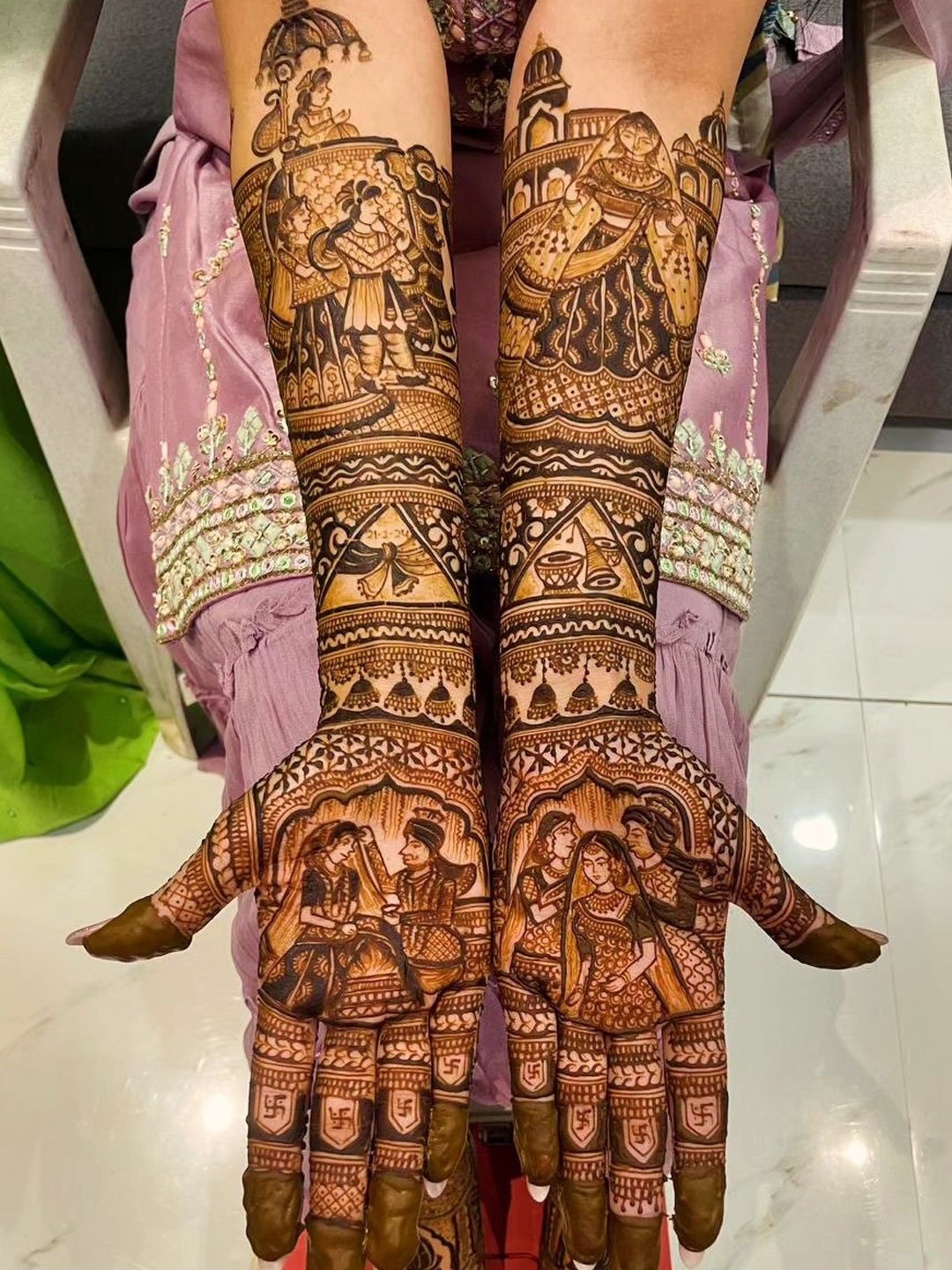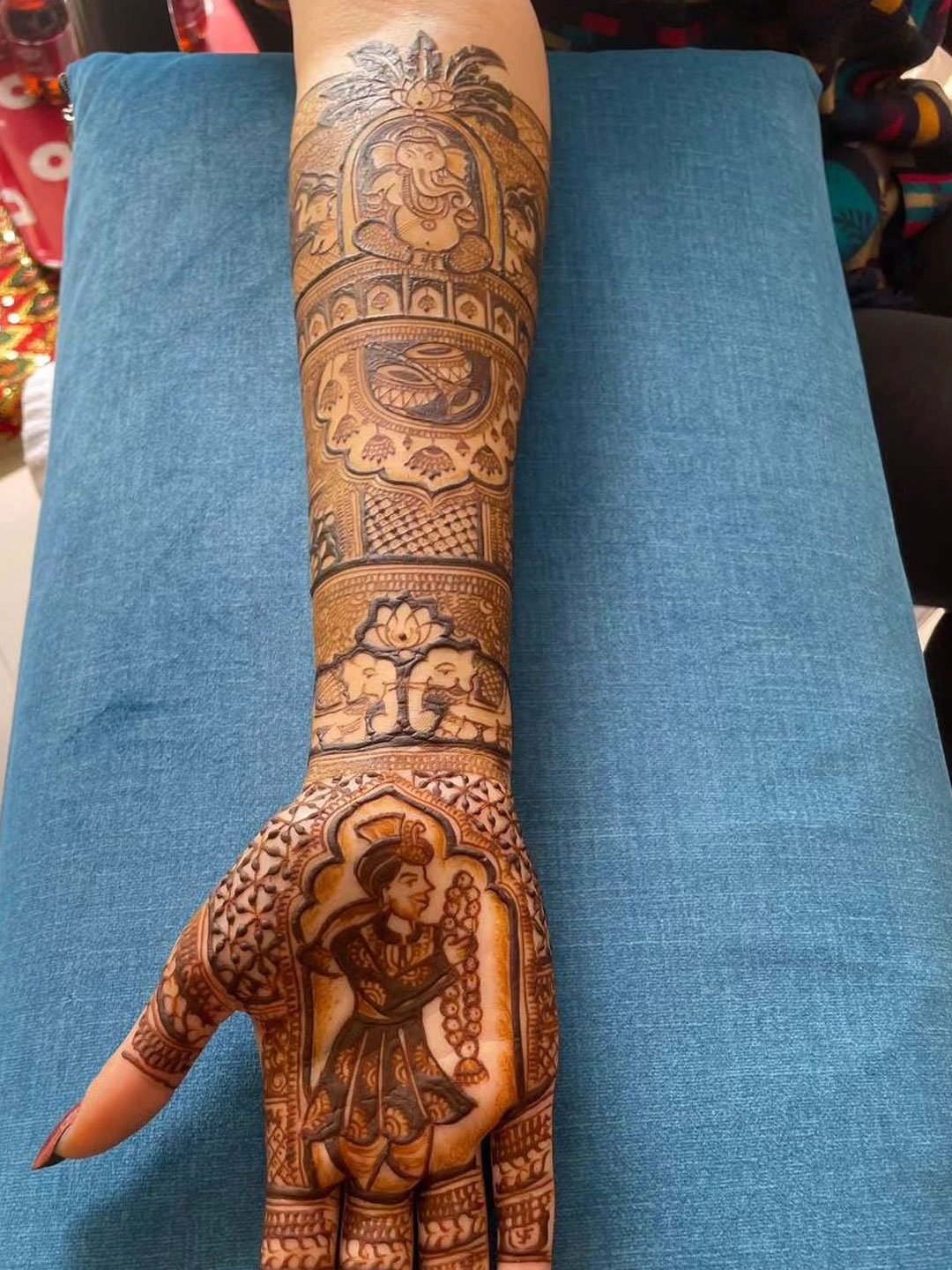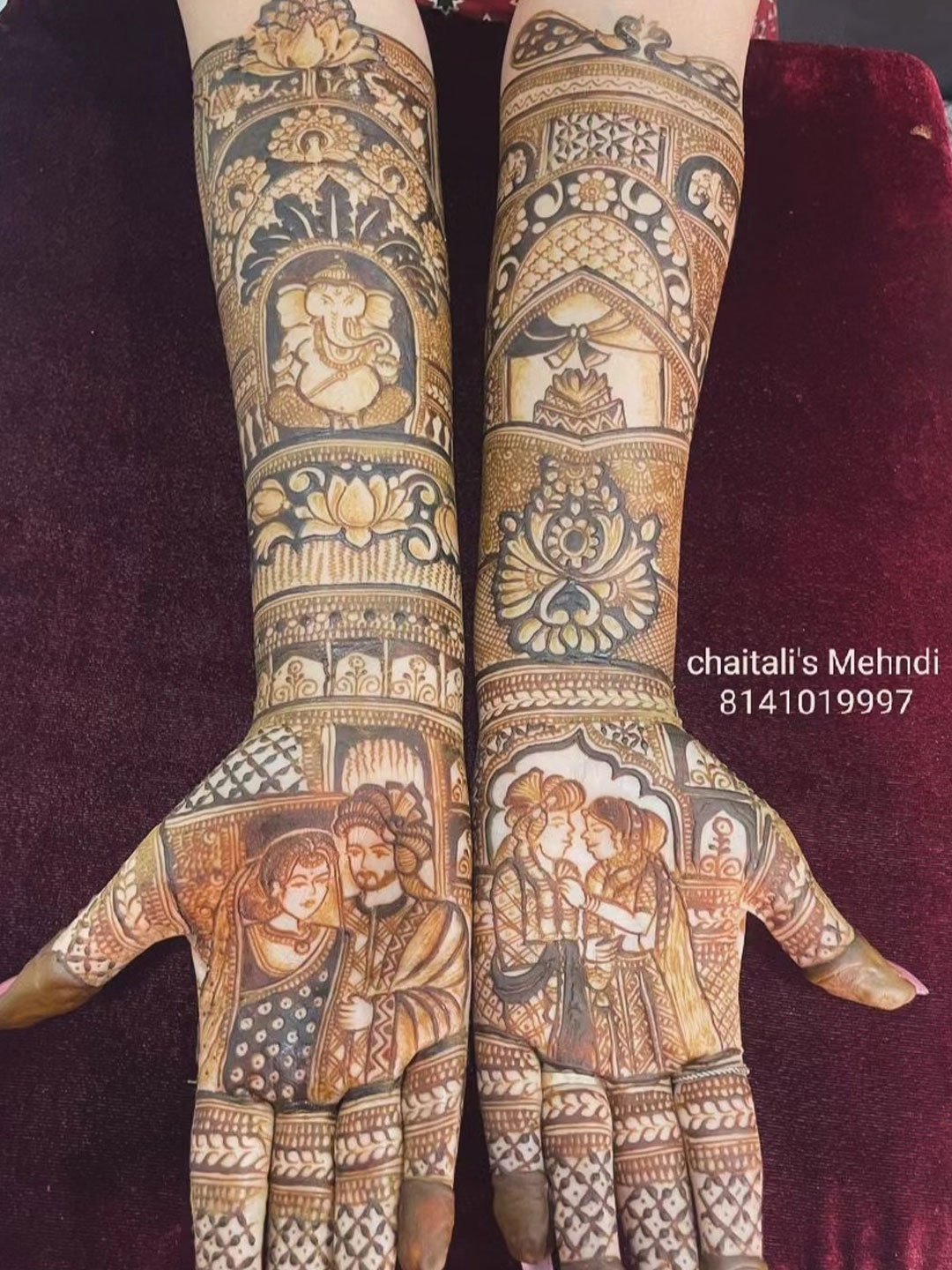
Somewhere along the way, mehndi stopped trying to imitate jewelry from a distance and started borrowing from it directly. Finger rings, bangle bands, and jhumka-shaped motifs drawn straight onto the skin have become one of the most requested details in modern bridal mehndi — not as a replacement for real jewelry, but as a way to make the hand itself look adorned even before a single ring goes on.
If you’ve scrolled through bridal inspiration pages recently, you’ve likely seen it: a finger wrapped in what looks like a delicate henna “ring,” a wrist banded like a bangle, or a fingertip finished with a dangling motif that echoes a jhumka earring. This style sits at the intersection of traditional mehndi artistry and jewelry design, and it’s earned its place as a signature look for brides who want their hands to feel complete on their own.
This guide walks through what jewelry-pattern mehndi actually is, the specific motifs that fall under this style, how it’s typically combined with real bridal jewelry, and what to discuss with your artist if you want this look for your own wedding.
What Is “Jewelry-Pattern” Bridal Mehndi?
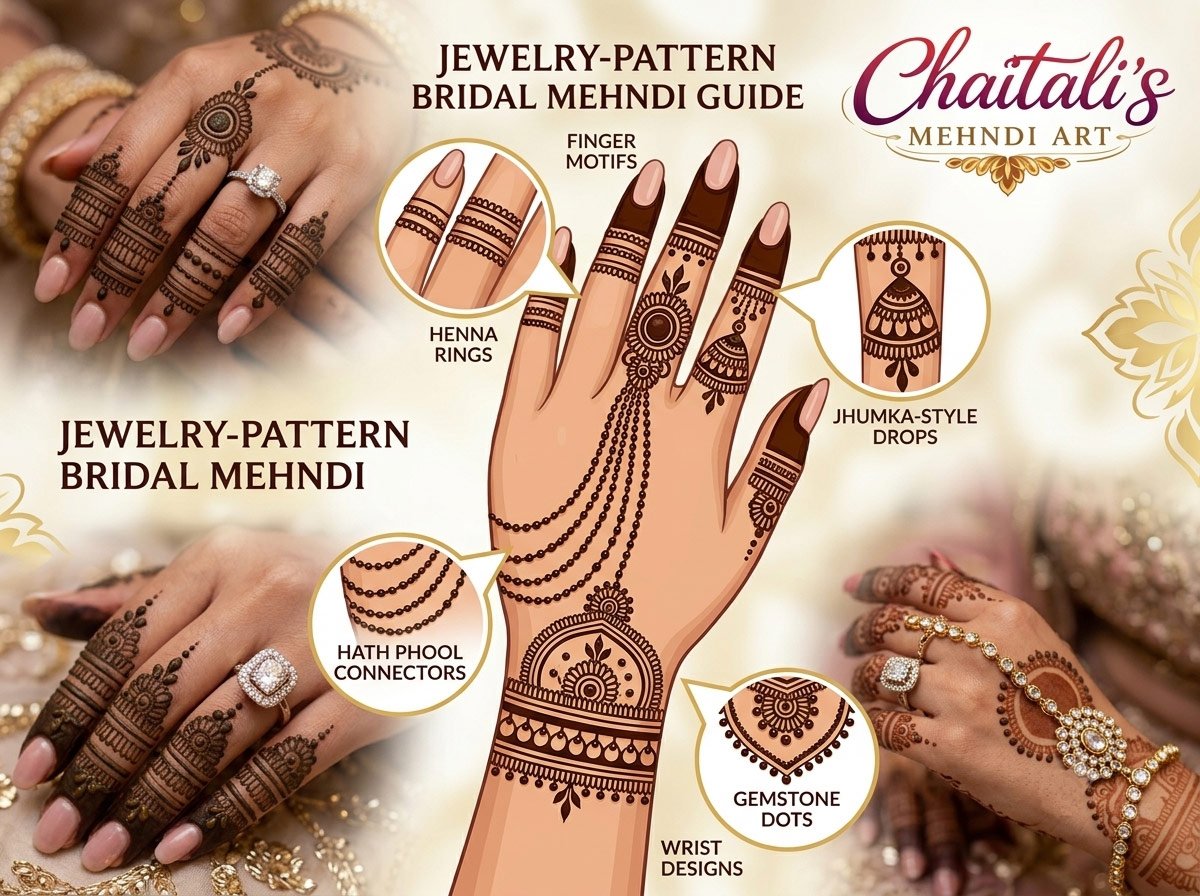
Jewelry-pattern mehndi is exactly what it sounds like: henna designs that are deliberately shaped to resemble actual pieces of jewelry rather than freeform florals, paisleys, or geometric fills. Instead of a vine trailing across the finger, you might see a fine band that mimics a ring sitting at the knuckle. Instead of an open lattice on the back of the hand, you might see a shape that echoes a hath phool — the traditional hand harness that connects a ring to a bracelet.
The appeal is fairly intuitive. A bride’s hands are already one of the most photographed parts of her on the wedding day, often shown mid-ceremony, holding hands with the groom, or resting during rituals like the pheras. Jewelry-inspired mehndi gives the hand a finished, ornamented look in every one of those shots, regardless of what actual jewelry is or isn’t visible at that moment.
It’s worth noting this is different from simply “leaving space for a ring.” Jewelry-pattern mehndi actively draws the shape of the ornament rather than working around it, which means the design carries its own visual weight even without any real jewelry layered on top.
Why This Style Has Become So Popular
A few practical reasons explain why finger-ring and jewelry-motif mehndi has moved from a niche request to a near-standard option in bridal consultations.
It photographs beautifully. Close-up hand shots — a common part of wedding photography and reels — look far more finished when the mehndi itself carries jewelry-like detail, rather than relying entirely on rings that might be removed for rituals like haldi or mehndi application itself.
It solves a real problem. Many brides take off their rings during the mehndi session so the artist can work freely, and sometimes don’t put heavy jewelry back on until later ceremonies. Jewelry-pattern mehndi means the hand never looks bare in between.
It layers naturally with real jewelry later. Rather than competing with an engagement ring, cocktail ring, or hath phool, a well-planned jewelry-motif design is built to sit alongside those pieces, so the henna and the actual ornament read as one cohesive look instead of two separate things fighting for attention.
It adds detail without adding density. For brides who don’t want an extremely heavy, fully filled hand, jewelry motifs offer a way to add ornamental richness in a contained, precise way rather than through broad coverage.
Popular Finger Ring and Jewelry Motifs in Bridal Mehndi
1. The Classic Mehndi “Ring” Band
A fine or moderately bold band wrapped around the base or mid-joint of a finger, designed to look like an actual ring. Some brides choose a single clean band, while others prefer a slightly wider version with tiny detailing along its edge, similar to a filigree ring.
2. Layered Stacked Rings
Instead of one band, two or three thinner bands are placed close together on the same finger, mimicking the look of stacked rings — a popular trend in real bridal jewelry that translates naturally into henna.
3. Hath Phool–Inspired Fingerwork
Perhaps the most iconic jewelry motif in bridal mehndi, this design draws a ring shape on one finger connected by fine lines running across the back of the hand to a wider “bracelet” band at the wrist, echoing the traditional hath phool ornament worn on the wedding day.
4. Jhumka-Style Fingertip Drops
A small dome or bell shape is drawn at the fingertip with a few fine lines hanging below it, resembling a miniature jhumka earring. This works especially well as an accent on the ring finger or middle finger.
5. Gemstone-Style Dot Clusters
Small clustered dots, sometimes arranged in a floral or teardrop shape, are placed within a ring band or bracelet motif to mimic the look of set stones — a subtle way to add texture without heavy fill.
6. Bangle-Band Wrist Detailing
Wide banded patterns encircling the wrist, styled to look like a stack of bangles, are a natural extension of finger-ring work and help tie the whole hand-and-wrist area into one ornamental composition.
7. Choker-Style Palm Centerpiece
Less common but increasingly requested, this design places a rounded, symmetrical motif at the centre of the palm styled after a choker necklace, often connected outward to finger rings by fine radiating lines.
8. Maang Tikka Echo on the Back of the Hand
Borrowing the teardrop-and-chain shape of a maang tikka, this motif is placed on the back of the hand near the wrist, occasionally connected to a finger-ring design for a fully coordinated jewelry theme across the hand.
9. Fine Chain-Link Connectors
Instead of solid lines, delicate chain-like linework connects a finger ring motif to the back-of-hand design, reinforcing the jewelry illusion with a texture that reads as metal rather than plain outline.
10. Solitaire-Style Fingertip Accent
A single, slightly larger motif — often a rounded flower or teardrop — is placed at the very tip of one finger to mimic a solitaire ring or fingertip jewel, usually reserved for the ring finger as a nod to the engagement ring itself.
How to Combine Jewelry-Pattern Mehndi With Real Bridal Jewelry
Since the entire point of this style is to complement actual jewelry, coordination matters more here than in most other mehndi styles.
Share your jewelry choices with your artist in advance. If you already know you’ll be wearing a hath phool, a particular ring style, or bangles in a specific width, sharing reference photos lets your artist design mehndi that visually continues those shapes rather than clashing with them.
Decide which fingers will carry real rings. If your engagement ring or a statement cocktail ring will sit on a particular finger, many brides prefer to keep that finger’s mehndi lighter or more open, so the real jewelry remains the visual focus there, while other fingers carry the fuller ring-motif detailing.
Think about layering, not competing. A henna hath phool motif paired with an actual hath phool later in the day tends to look intentional and rich rather than repetitive, especially when the henna version is positioned slightly differently — for instance, on the opposite hand or with subtler detailing.
Plan around removable jewelry timelines. Since rings often come off for the mehndi application itself and may not go back on until later functions, jewelry-pattern mehndi is especially popular for the hand that will spend the most time bare of real jewelry over the wedding weekend.
Where This Style Works Best on the Hand
Jewelry-motif mehndi doesn’t need to cover the whole hand to make an impact, which is part of why it suits such a wide range of overall bridal styles.
As an accent within a fuller design. A single hath phool motif or a set of stacked-ring fingers can sit beautifully within an otherwise traditional, fully filled bridal mehndi design, adding a focal point without disrupting the rest of the composition.
As the centrepiece of a minimalist design. For brides who prefer lighter, more contained mehndi overall, jewelry motifs offer a way to make a strong visual statement without needing dense coverage across the whole hand.
Combined with lace or net-style palm work. Open lattice or net patterns on the palm pair especially well with jewelry motifs on the fingers, since both styles rely on fine detail and open space rather than heavy fill, keeping the whole hand visually balanced.
Tips for Discussing This Look With Your Artist
- Bring reference photos of specific jewelry pieces, not just general mehndi inspiration. A photo of your actual hath phool, ring style, or bangle set gives your artist something concrete to translate into a matching motif.
- Mention which fingers will wear real rings on the wedding day, so your artist can plan lighter or open space accordingly on those fingers.
- Ask about symmetry between both hands. Some brides prefer matching jewelry motifs on both hands, while others prefer one hand with jewelry detailing and the other with a more traditional design — both are common, so it’s worth stating your preference upfront.
- Consider your ceremony sequence. If jewelry changes between events — engagement, mehndi function, wedding day — let your artist know which look matters most for which occasion, since the mehndi will stay constant across all of them.
- Ask to see the artist’s previous jewelry-style work specifically, since this is a more specialised technique than general floral or paisley fill, and not every mehndi artist emphasises it in their portfolio.
How Long Does Jewelry-Pattern Detailing Take?
Fine ring bands and chain-link connectors are generally quick to apply compared to dense floral fill, since the technique relies on precision rather than volume. Larger centrepiece motifs, like a full hath phool design connecting the finger to the wrist, take a bit more time due to the connecting linework involved, but still typically fit comfortably within a standard bridal mehndi session alongside the rest of the hand and palm design.
Frequently Asked Questions
Will jewelry-pattern mehndi look strange without matching real jewelry? No. These motifs are designed to look complete and intentional on their own, which is part of why the style has become so popular — they don’t rely on real jewelry being present to look finished.
Can this style be added to an already-planned traditional design? Yes. Jewelry motifs are usually added as accents within a larger composition, so they can be incorporated into almost any existing bridal mehndi plan without needing to redesign the whole hand.
Is this style only for the hands, or can it work on feet too? It works well on feet too — anklet-style bands around the ankle and toe-ring motifs on the toes follow the same principle and are a popular way to extend the jewelry theme to bridal foot mehndi.
Does jewelry-pattern mehndi cost more than standard bridal mehndi? It depends on the complexity and number of motifs involved, similar to how any detailed accent work is priced. It’s best discussed directly during your consultation once your artist understands how many jewelry motifs you’d like included.
Should I choose this style if I’m not wearing much jewelry on the wedding day? It can actually work especially well in that case, since the mehndi itself provides the ornamental detail your hand would otherwise be missing.
Final Thoughts
Jewelry-pattern bridal mehndi bridges two of the most important elements of a bride’s look — her henna and her ornaments — into a single, cohesive design. Whether it’s a fine ring band on one finger, a full hath phool motif connecting hand to wrist, or a jhumka-inspired drop at the fingertip, this style adds a layer of intentional, ornamental detail that holds up beautifully in every photograph, with or without real jewelry layered on top.
If you’re planning your wedding mehndi and want finger-ring or jewelry-inspired motifs designed around your actual bridal jewelry, Chaitali’s Mehndi Art offers personalised bridal mehndi consultations, engagement mehndi, and portrait mehndi services across Ahmedabad. Get in touch to start planning a design that brings your henna and your jewelry together.