
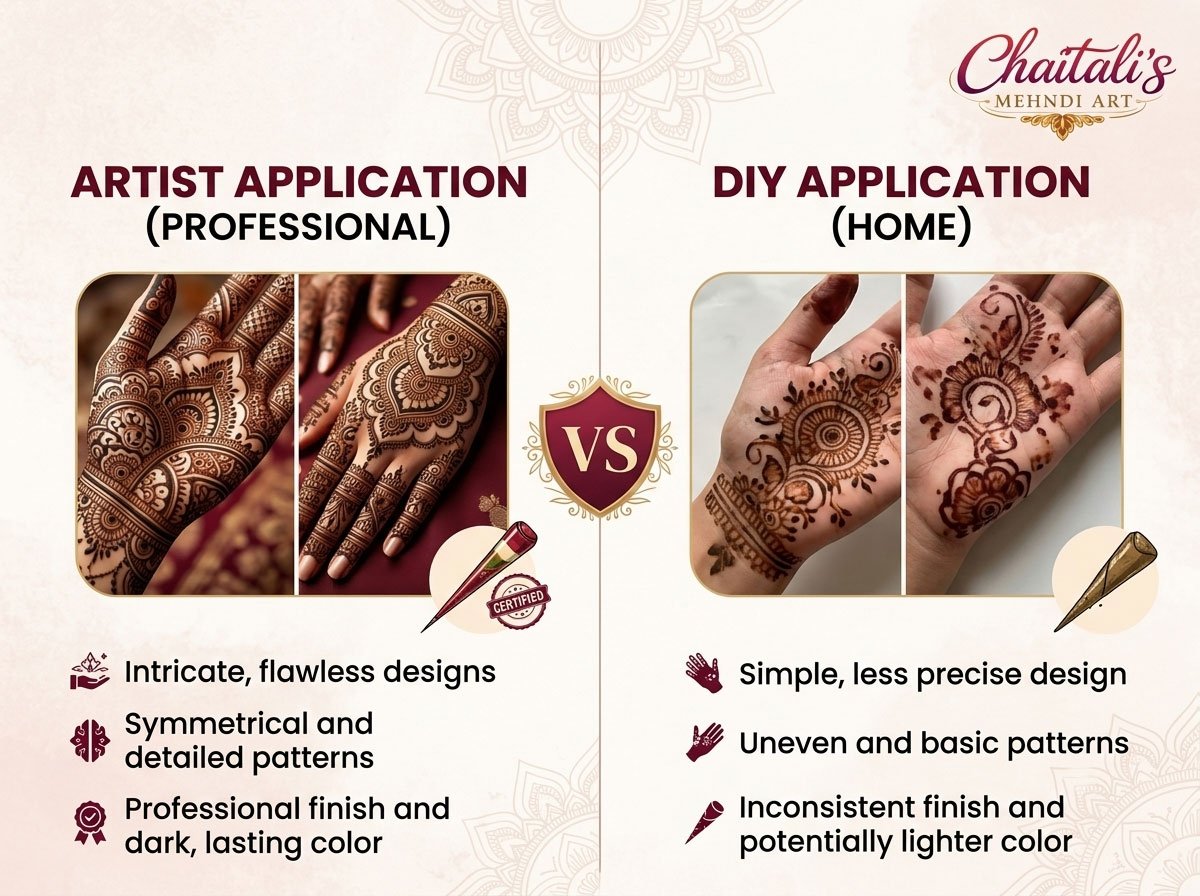
Every bride has had the thought at least once: “Why not just do my own mehndi, or ask a cousin to do it?” Between tutorial videos, ready-made cones and a family member who “draws really well,” DIY mehndi can feel like an easy way to save money and keep things personal.
For a casual evening or a small festival, it can work. But for a bridal look, an engagement or any event that will be photographed for decades, the gap between DIY mehndi and professional application is wider than most people expect. It shows up in the stain, the design, the finish, the safety of the paste and, above all, in how relaxed you feel on the day.
In this guide, we at Chaitali’s Mehndi Art compare a professional mehndi artist and DIY mehndi honestly, so you can decide what is right for your occasion.
What DIY Mehndi Really Involves
Doing mehndi yourself is more than squeezing a cone. You need to source a paste, prepare your skin, plan a design, draw it cleanly on your own hand (which is far harder than drawing on someone else’s), then protect it for hours while it dries and develops colour.
Most beginners underestimate three things: how steady the hand needs to be, how long a full design takes, and how difficult it is to draw on your own non-dominant hand. You are also working at an awkward angle, so lines drift, patterns lose symmetry and the second hand rarely matches the first.
A professional handles all of this every week. That experience is what you are really paying for.
1. Paste Quality and Ingredient Safety
The single biggest difference between professional and DIY mehndi is what goes into the cone.
Ready-made cones sold in markets and online vary hugely in quality. Some are freshly made with natural henna powder, while others are old, diluted or loaded with additives to make the colour appear faster. A major red flag is any product marketed as “black henna.” Natural henna gives a reddish-orange to deep brown stain, never jet black. Products that promise black colour in minutes often contain chemical dyes such as PPD (para-phenylenediamine), which can cause severe skin reactions, blistering and lasting scars.
A professional artist prepares or sources paste they trust, adjusts consistency for fine lines versus bold fills, and knows what a safe mix should look like. At Chaitali’s Mehndi Art, we focus on quality henna because it protects both your skin and your design. If you have sensitive skin or past reactions, tell your artist before the session so the application can be planned around it.
2. Design Skill, Symmetry and Clean Lines
A beautiful mehndi design is part art, part engineering. Professionals train for years to master:
- Consistent line thickness from hairline details to bold outlines
- Symmetry and balance between both hands and across the palm and back of the hand
- Spacing and flow so patterns connect naturally from fingertips to forearm
- Figurative work such as peacocks, portraits and bridal scenes, which need real artistic skill
This is why complex bridal work looks so different when drawn by an expert. A bridal mehndi design isn’t just filled space; it is planned so that every motif has room to breathe. Even a single detailed motif can show the difference. In our guide to peacock motifs in bridal mehndi, we explain how a peacock has anatomy, proportion and a tail that must look as if it is truly fanning. A head that is slightly too large or a neck that is too straight and the whole motif looks stiff.
If you want a portrait or a face worked into your design, professional skill is not optional. Our portrait mehndi service exists because capturing a likeness in henna takes a very controlled hand and plenty of practice. You can see the range of finished work in our gallery.
3. Stain Depth and How Long It Lasts
Every bride wants a rich, dark stain. Colour depends on the quality of the paste, the preparation of your skin, the thickness of application, how long the paste stays on and the aftercare you follow.
With DIY mehndi, any of these can go wrong. Paste that is too thin, lines that are too light or a design that cracks and flakes off early can all lead to a pale, patchy stain. Professionals apply paste with the right thickness and pressure, and give you clear aftercare instructions so the colour develops fully.
Skin preparation matters too. Our guide on how to prepare your skin before a bridal mehndi session explains the simple steps that help the stain take well. And once your mehndi is done, our article on how to make mehndi colour darker and last longer walks you through aftercare that protects your work. Good aftercare helps either way, but it can’t fix a poorly applied design.
4. Time, Stress and the Wedding Schedule
A full bridal design for both hands and feet can take several hours. A detailed full-arm design takes even longer. Doing that yourself is nearly impossible: you cannot draw on both hands at once, and once one hand is done you can barely use it to draw on the other.
That is why DIY bridal mehndi usually means asking friends or relatives to step in. That sounds sweet, but it often adds stress during an already busy week. Meanwhile, a professional arrives prepared, works efficiently and finishes on time so you can sit back, relax and stay on schedule.
Timing matters when you book as well. Wedding dates in Ahmedabad fill up quickly, so read our guide to the best months to book your mehndi artist and plan ahead.
5. Hygiene and Skin Care
Professional artists work with clean hands, clean tools and fresh cones. They notice problems that a beginner would miss, like broken skin, a rash or an area that is too dry to hold the paste.
With DIY mehndi, hygiene is easy to overlook. Reused cones, old paste and unwashed hands can all introduce irritation. On your own wedding day, you do not want to worry about a skin reaction.
6. The Real Cost: DIY vs Professional
DIY mehndi looks cheaper on paper, since a few cones cost very little. But the true cost includes more than the price of the paste.
- Wasted cones and retries when designs go wrong
- Time spent practising and applying, often over many hours
- Touch-ups or a design you are not happy with in photos
- The risk of a poor stain that you will see in every wedding picture
A professional service is an investment in a result that lasts, in photographs, in memories and in your confidence. When you consider that bridal hands are among the most photographed parts of a wedding, the value becomes clear. For help planning your budget, explore our bridal mehndi packages or contact us for a personalised quote.
7. Customisation for Every Occasion
A good artist does more than copy a design. They listen to your outfit, jewellery, skin tone and personal story, then build a design to match.
Professional artists can adapt their work to many occasions:
- Engagement mehndi with delicate, elegant detailing. See our ideas in mehndi designs for engagement ceremonies.
- Festival mehndi for celebrations such as Diwali. Read our complete guide to Diwali mehndi designs.
- Karva Chauth mehndi with traditional symbols and motifs
- Baby shower mehndi with soft, joyful designs
- Sider mehndi for family members who want to join in on the day
- Group mehndi so bridesmaids and relatives can all be done efficiently
For modern celebrations, professionals also understand how mehndi looks on camera. Our article on pre-wedding shoot mehndi explains how design, timing and placement change what shows up in photographs.
Artist vs DIY: Quick Comparison
| Factor | Professional Mehndi Artist | DIY Mehndi |
|---|---|---|
| Paste quality | Trusted, fresh, safe | Varies; risk of additives |
| Design detail | Fine lines, symmetry, figurative work | Basic patterns for beginners |
| Stain depth | Even, rich, long-lasting | Often patchy or light |
| Time needed | Efficient, finished on schedule | Slow, tiring, hard on both hands |
| Skin safety | Experienced, careful | Higher risk with unknown cones |
| Photos | Looks polished in close-ups | Flaws show in close-ups |
| Stress | Low, you just sit and relax | High, especially before weddings |
When DIY Mehndi Does Make Sense
We are not against DIY. In fact, there are times when it is a great choice:
- A small, simple design for a casual get-together
- Practising as a hobby or for fun with friends
- A quick, minimal accent on one finger or wrist
- Learning the craft before taking it further
If you want to learn properly, our mehndi class teaches the techniques that professionals use, so your practice builds real skill rather than bad habits. You can also browse the shop for supplies. Learning the craft is a lovely way to appreciate how much skill goes into professional work.
How to Choose the Right Mehndi Artist
If you decide to hire a professional, a little research goes a long way. Look for:
- A portfolio that matches your style. Check that the artist has done the kind of work you want, whether traditional, Arabic, minimalist or figurative.
- Clear communication. A good artist asks about your outfit, event and preferences instead of rushing through.
- Real reviews. Read what other brides say. Our page on why brides recommend us shows what to look for in client feedback.
- Transparent booking details. You should know timing, pricing and what is included before you confirm.
- Safe, natural paste. Do not hesitate to ask what is in the mix.
Have more questions? Our bridal mehndi FAQs answer the most common ones from Ahmedabad brides, and our guide on mehndi trends to watch in 2026 can help you pick a style before you book.
Frequently Asked Questions
Is professional mehndi really worth the extra cost? For weddings and major events, yes. The difference in design quality, stain depth, safety and stress levels is something you will see in every photograph and feel on the day.
Can I do my own bridal mehndi if I am good at drawing? It is possible for a small, simple design, but a full bridal design is very hard to draw on yourself. Drawing on your own hand, getting symmetry and managing several hours of work is far more difficult than it looks.
Are ready-made mehndi cones safe? It depends on the brand and ingredients. Avoid any product labelled “black henna” or promising instant dark colour, as these can contain harmful chemical dyes. If you have sensitive skin, speak to your artist beforehand.
How far in advance should I book a mehndi artist? During the busy wedding season, book as early as you can. Our guide to wedding season in Ahmedabad explains how to time it.
Will a professional design look the same on my skin as in photos? Stain depth varies from person to person, but a professional uses good paste and correct technique, and gives aftercare advice so your colour develops as well as it can.
Final Thoughts
DIY mehndi has its place, and learning the art is a rewarding hobby. But when the occasion matters, such as your wedding, engagement or a milestone celebration, professional application gives you safer paste, finer design, a deeper stain and, perhaps most importantly, peace of mind. You get to enjoy the moment while an expert takes care of your hands.
If you are planning an event in Ahmedabad and want a design made just for you, Chaitali’s Mehndi Art is here to help with everything from bridal mehndi to engagement and festival designs. Get in touch today to check availability and start planning. You can also explore more ideas on our blog or browse the Mehndi category.