Not every hand is built the same, and mehndi artists know this better than anyone. A design that looks stunning on a long, slender hand can sometimes feel cramped or overwhelming on shorter fingers — not because shorter fingers are any less beautiful, but because certain patterns simply aren’t designed with that hand shape in mind. The good news is that mehndi is one of the most adaptable art forms there is, and with the right design choices, shorter fingers can look every bit as elegant and elongated as any other hand shape.
If you have shorter fingers and are planning your bridal mehndi, this guide walks through why certain patterns work better than others, the design styles that tend to flatter this hand shape most, and practical tips to keep in mind when you sit down with your artist.
Why Design Choice Matters More Than Hand Shape
It’s worth saying clearly upfront: shorter fingers don’t limit what’s possible with bridal mehndi. What they do is change which design choices will make the hand look its most elegant. The same way certain jewellery cuts or nail shapes are chosen to complement a particular hand, mehndi patterns can be chosen and adapted specifically to work with shorter fingers rather than against them.
The main principle experienced artists rely on is this: patterns that run vertically along the length of the finger tend to create a visual sense of elongation, while patterns that wrap heavily around the width of the finger, or stop abruptly partway up, can visually shorten it further. Beyond that, the density and placement of the design across the whole hand — not just the fingers themselves — plays a big role in how proportionate the overall look feels.
None of this means shorter fingers need to be handled cautiously or minimally. It simply means the pattern needs to be chosen with a bit more intention.
Design Principles That Flatter Shorter Fingers
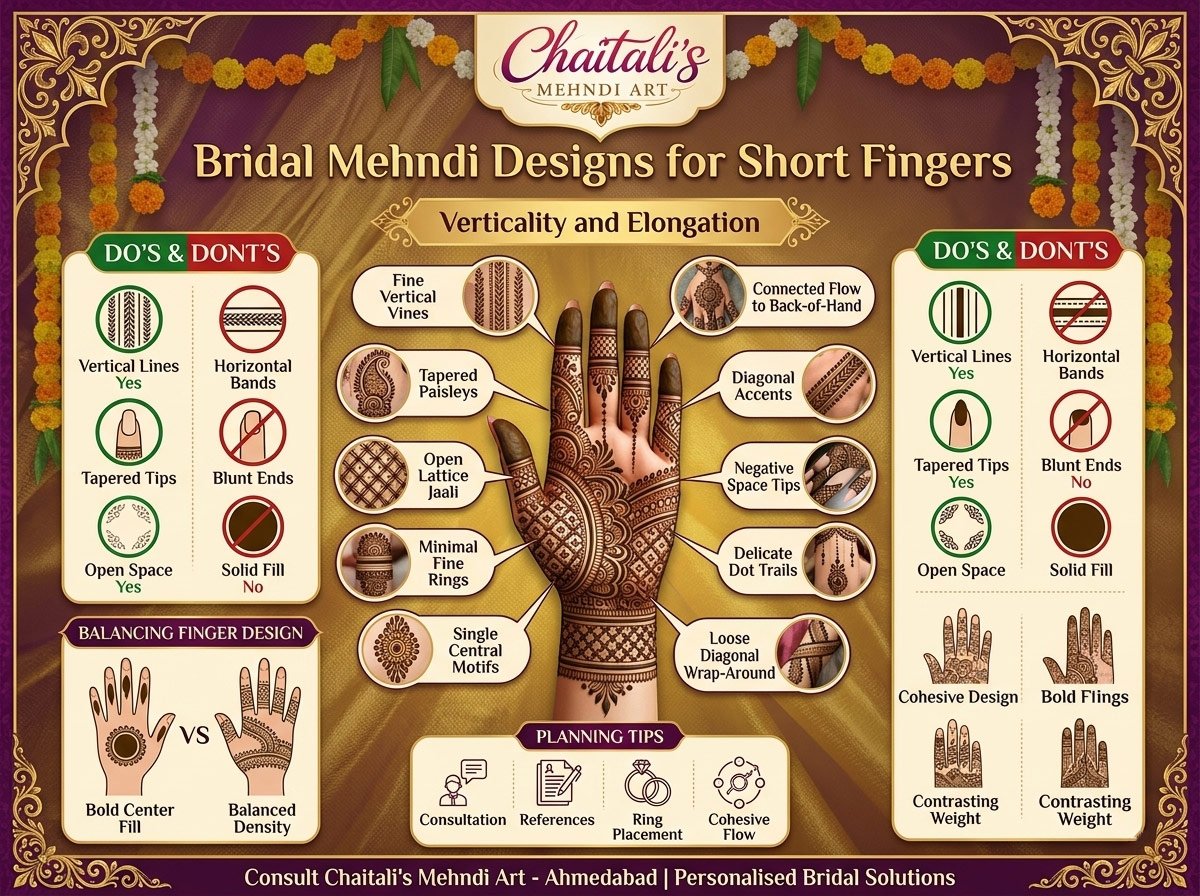
Vertical lines and elongating patterns. Fine vertical lines, tapering vine trails, or elongated paisley shapes running up the length of each finger create the visual effect of added length, drawing the eye upward rather than across the width of the finger.
Tapered fingertip detailing. Rather than a bold block of colour or a wide motif at the fingertip, a tapered design that narrows toward the tip — like a fine point or a small elongated teardrop — keeps the finger looking proportionate rather than visually cut off.
Avoiding wide horizontal bands. A thick horizontal ring or band wrapped around a shorter finger tends to visually shorten it further, since it draws the eye across the width rather than along the length. Thinner, more delicate horizontal accents work far better if some horizontal element is wanted.
Open space between elements. Leaving small gaps of bare skin between motifs, rather than filling every millimetre of the finger, keeps the overall look airy rather than compressed — a compressed, overly dense finger design can make shorter fingers look stubbier by comparison.
Extending the design onto the back of the hand. Letting fingertip patterns flow into a connected design on the back of the hand, rather than treating each finger as a separate, self-contained motif, helps the whole hand read as one elongated composition instead of a series of short, disconnected sections.
Bridal Mehndi Designs Well Suited to Shorter Fingers
1. Fine Vertical Vine Trail
A slim floral or paisley vine runs up the centre of each finger from the base to a tapered point near the tip. The unbroken vertical line is one of the most reliably elongating patterns available, and it works beautifully paired with denser back-of-hand or palm detailing.
2. Tapered Paisley Fingertips
Each fingertip finishes in a single elongated paisley shape, narrower at the top than the base, drawing the eye upward rather than stopping the design abruptly at the fingertip.
3. Open Lattice Fingerwork
A delicate, open jaali (net) pattern with generous spacing between the lines runs along each finger, giving the impression of coverage and detail without the visual density that can shorten the look of the finger.
4. Minimalist Fine-Line Rings
Rather than a wide mehndi “ring” band, this style uses one or two very fine lines circling each finger at the base and mid-point, adding delicate detail without the shortening effect of a bold horizontal band.
5. Single Central Motif Per Finger
Instead of covering the whole finger, a single small motif — a flower, a leaf, or a tiny paisley — is placed centrally on each finger with open space above and below it, keeping the look light and proportionate.
6. Connected Fingertip-to-Hand Flow
Fine linework begins at each fingertip and flows continuously into a larger connected pattern on the back of the hand, so the fingers read as an extension of the overall design rather than isolated sections.
7. Diagonal Accent Lines
Rather than straight vertical or horizontal lines, subtle diagonal linework across the finger can create a similar elongating effect while adding a slightly more contemporary visual texture to the design.
8. Negative Space Fingertip Design
Fine outlining is used to frame small sections of bare skin at the fingertip, rather than filling the tip solidly with henna. This negative-space approach keeps the finger looking light and long rather than heavy at the tip.
9. Delicate Dot Trail
A slim vertical trail of small dots, gradually decreasing in size toward the fingertip, offers one of the lightest, most minimal elongating options — ideal for brides who want a subtle, modern finish overall.
10. Wrap-Around Vine with Tapered End
A thin vine wraps loosely and diagonally around the finger rather than sitting as a straight horizontal band, tapering to a fine point as it reaches the tip — giving movement to the design while still avoiding the width-emphasising effect of a straight ring pattern.
What to Be Mindful Of
A few design choices tend to work against shorter fingers, and it’s worth knowing them even if you don’t plan to avoid them entirely.
Very wide horizontal bands across the base or middle of the finger tend to visually shorten it, since they emphasise width over length.
Heavy, solid fill covering the entire finger with little to no open space can make the finger look compressed rather than elegant, particularly compared to a design with more breathing room.
Motifs that stop abruptly with a hard edge at the fingertip, rather than tapering or fading gradually, can make the finger look visually cut off at that point.
None of these are off-limits — plenty of brides love a bold banded look regardless of finger length, and personal preference should always come first. But if elongation is a priority, these are the patterns worth discussing with your artist before finalising the design.
Balancing Finger Design With the Rest of the Hand
Since finger detailing is only part of the overall bridal mehndi look, how it connects to the palm and back-of-hand design matters just as much as the finger pattern itself.
Denser palm or back-of-hand work paired with lighter, elongated fingers is one of the most flattering combinations for shorter fingers, since it keeps visual weight concentrated where there’s more open canvas, while the fingers stay light and vertically oriented.
A continuous design that flows from fingertip to wrist avoids the fingers looking like a separate section entirely, which helps the whole hand read as one cohesive, elongated composition rather than fingers and hand competing for attention.
Avoiding equally dense fill on both the fingers and the rest of the hand helps prevent the overall look from feeling heavy — contrast between a lighter finger treatment and a bolder centrepiece elsewhere tends to look more balanced.
Tips for Planning This With Your Artist
- Mention your priority upfront. Telling your artist directly that you’d like your fingers to look as elongated as possible helps them choose patterns and orientations accordingly from the start of the consultation.
- Ask to see finger-specific reference photos, not just full-hand designs. Many portfolios are organised around palm or back-of-hand centrepieces, so it’s worth asking your artist directly for examples of their fingertip work.
- Discuss ring placement if you’re wearing an engagement ring during application. Your artist can plan the design to complement rather than compete with a ring you’ll be wearing on the day.
- Think about how the fingers connect to the rest of the design, not just the fingers on their own. A cohesive flow from fingertip to wrist tends to look more elegant than fingers treated as a separate block.
- Trust your artist’s read on your specific hand. Every hand is proportioned slightly differently, and an experienced mehndi artist will often have specific suggestions once they see your hand in person.
How Long Does Fingertip-Focused Detailing Take?
Fine, elongating fingertip work is generally quicker to apply than dense, heavily filled finger patterns, since the technique relies on precision rather than volume. As part of a full bridal mehndi session, fingertip detailing typically adds a modest amount of time beyond the palm or back-of-hand centrepiece — usually well within the same overall session length as a standard bridal appointment, since the open, minimal style of most elongating patterns doesn’t require extensive fill work.
Frequently Asked Questions
Do I need a minimalist overall design if I have shorter fingers? No. Shorter fingers pair well with either a minimalist or a fully traditional bridal look — the key is choosing the right finger-specific pattern, not necessarily simplifying the whole design.
Can I still get a mehndi “ring” design if I have shorter fingers? Yes, though a finer, thinner ring line tends to work better than a bold, wide band, which can visually shorten the finger more than a delicate version of the same idea.
Will vertical patterns look strange if the rest of my hand has a different design style? Not if the transition is planned well. A skilled artist can connect a vertical, elongating finger pattern into virtually any palm or back-of-hand style, whether traditional, floral, or geometric.
Is this something I need to specifically request, or will artists account for it automatically? It’s worth mentioning directly. While experienced artists often adjust naturally based on what they see, being specific about wanting an elongating effect ensures it’s a deliberate part of the design plan rather than an assumption.
Does this apply to toes and feet as well? Yes, similar principles apply to foot mehndi — vertical, tapered patterns along the toes tend to create a similar lengthening effect, and the same open-spacing approach works well there too.
Final Thoughts
Shorter fingers are not a limitation in bridal mehndi — they’re simply a starting point that calls for slightly different design choices than a longer, slender hand might. With vertical linework, tapered fingertip detailing, and thoughtful spacing, it’s entirely possible to create a bridal mehndi design that makes shorter fingers look elegant, elongated, and completely at home within a stunning overall composition.
If you’re planning your wedding mehndi and want a design tailored specifically to your hand shape and proportions, Chaitali’s Mehndi Art offers personalised bridal mehndi consultations, engagement mehndi, and portrait mehndi services across Ahmedabad. Get in touch to start planning a design built around exactly the hand you have.