For years, mehndi conversations in Indian weddings revolved almost entirely around the bride. The groom’s hands, if they got henna at all, usually ended up with a single token motif applied in under five minutes, almost as an afterthought. That’s changed. Grooms today — especially in cities like Ahmedabad, where wedding styling has become as detail-oriented for men as it is for women — are actively asking for their own mehndi design. Not a copy of the bride’s pattern scaled down, but something that reflects a different aesthetic altogether: clean, masculine, understated, and deliberately not overdone.
At Chaitali’s Mehndi Art, we’ve seen groom’s mehndi bookings grow every wedding season, and the brief is almost always the same: “Make it stylish, but keep it subtle.” This guide breaks down exactly what that means in practice — the design styles gaining popularity, where they work best on the hand, how they pair with sangeet and wedding outfits, and what to ask for when you book your session.
Why Groom’s Mehndi Deserves Its Own Design Language
A bridal mehndi design and a groom’s mehndi design are solving two completely different problems. Bridal mehndi is meant to be dense, intricate, and camera-ready — it’s often the single most photographed detail of the wedding. Groom’s mehndi has a different job: it needs to look intentional and well-designed without competing with the rest of the groom’s look — the sherwani, the safa, the watch, the overall silhouette of the outfit.
That’s why the best groom’s mehndi designs share a few common traits:
- Restrained coverage — usually limited to the palm, the back of the hand, or a section of the wrist, rather than covering the entire hand and forearm.
- Clean linework over dense filling — fine strokes and open space matter more than layering pattern on pattern.
- Symbolic motifs — a name, an initial, a date, or a meaningful symbol worked in subtly rather than displayed as the centerpiece.
- Neutral placement — designs are chosen so they still look sharp with a watch, kalgi, or ring on the same hand.
Understanding this distinction is the first step to getting a design you’ll actually be happy to see in every wedding photo, rather than one you keep your hand tucked away to hide.
Popular Subtle & Stylish Groom’s Mehndi Designs This Season
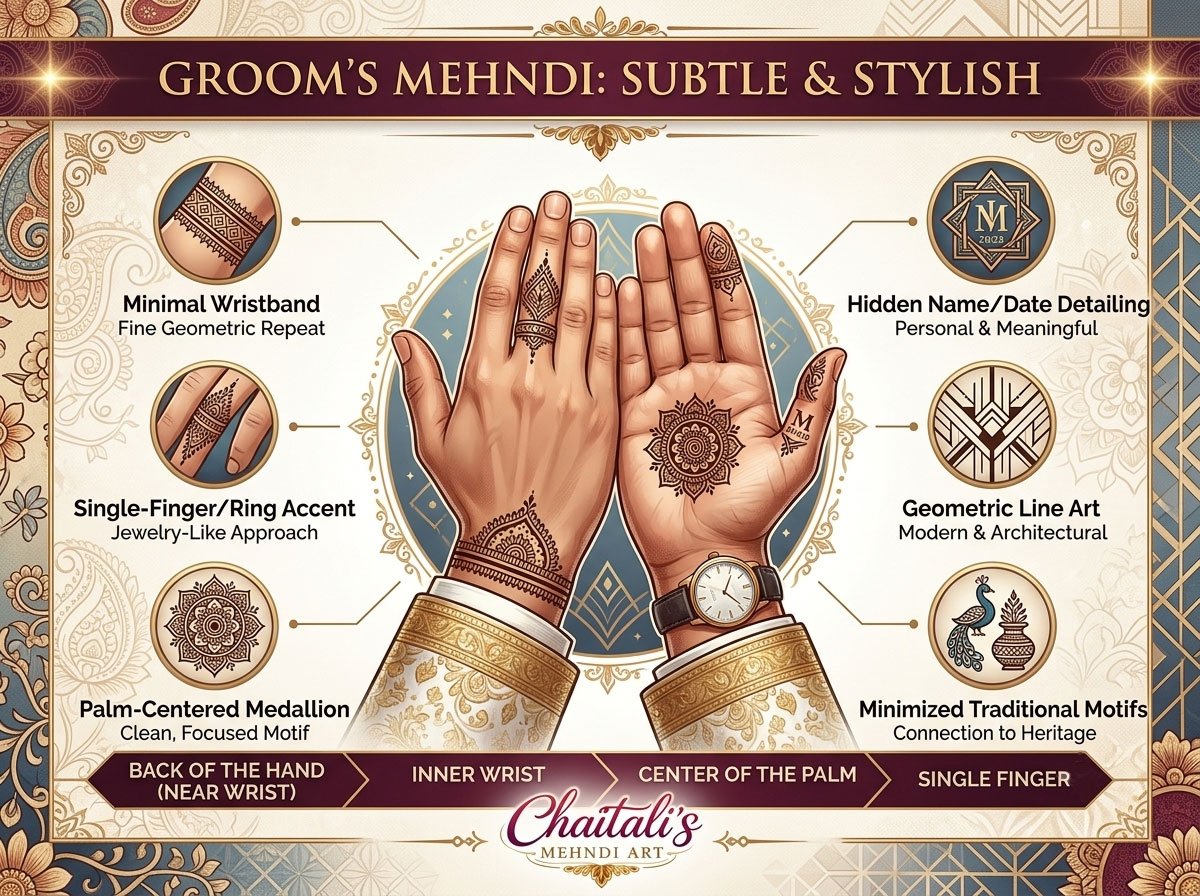
1. Minimal Wristband Mehndi
This is currently the most requested style among grooms booking with us. Instead of covering the palm, the design wraps around the wrist like a bracelet — fine linework, a small geometric or floral repeat, sometimes finished with a thin trailing vine toward the base of the fingers. It photographs beautifully under a kalgi or watch and takes a fraction of the time a full-hand design would.
2. Single-Finger or Ring-Finger Accent
A quiet, almost jewelry-like approach — a delicate pattern circling just the ring finger or one or two fingers, echoing the idea of a wedding band before the rings are even exchanged. It’s become especially popular for grooms who want a nod to tradition without any mehndi on the palm at all.
3. Palm-Centered Medallion
For grooms who want a slightly more visible design without going overboard, a single, well-proportioned medallion or mandala-style motif placed in the center of the palm works well. The rest of the hand stays bare, which keeps the overall effect clean rather than busy.
4. Hidden Name or Date Detailing
A popular request during sangeet and pre-wedding sessions — the bride’s name, initials, or the wedding date worked subtly into a small design, often disguised within a geometric pattern or leaf motif so it isn’t obvious at first glance. It’s a personal, meaningful touch that guests rarely notice unless the groom points it out.
5. Geometric Line Art
Straight lines, triangles, and structured repeating shapes have become a strong alternative to floral motifs for grooms who want something modern and architectural rather than traditional. This style pairs particularly well with contemporary sherwanis and Indo-western wedding outfits. If you’re drawn to this look, it’s worth browsing our post on Geometric Bridal Mehndi Designs for a Modern Bride for design inspiration that translates well into a scaled-down groom’s version.
6. Traditional Motifs, Minimized
Some grooms still want a connection to heritage — a small peacock, a kalash, or a paisley — but scaled down to a single small motif rather than filling the hand. This works especially well for families who value ritual continuity between the bride’s and groom’s mehndi without matching them exactly.
Where to Apply It: Placement Matters More Than Size
One of the most common questions we get from grooms is simply: “Where should this even go?” Placement has a bigger impact on how “subtle” a design feels than the pattern itself. A few placement guidelines that consistently work well:
- Back of the hand, near the wrist — visible in most hand gestures during rituals like the varmala and pheras, without taking over the whole hand.
- Inner wrist — ideal for a design you want visible when the sleeve is pushed up slightly, but hidden under a full-sleeve sherwani otherwise.
- Center of the palm — best for a single accent motif; keeps the design visible during hand-holding rituals like Hast Melap.
- Single finger or two fingers — the most understated option, best for grooms who want almost no visible mehndi beyond a small personal detail.
If you’re getting mehndi done alongside your fiancée for an engagement or sangeet event, it’s worth reading our piece on Bridal Mehndi with Finger Rings and Jewelry Patterns — several grooms have used similar ring-style placement ideas for a complementary, matching-but-not-identical look with the bride.
Groom’s Mehndi for Different Wedding Events
Groom’s mehndi isn’t limited to the wedding day itself. Depending on the family’s traditions, it can appear across several pre-wedding functions:
Engagement: A very light, symbolic touch — often just initials or a small motif — is common, especially when both partners are getting mehndi done together. See our dedicated Engagement Mehndi service for more on how we approach paired designs for couples.
Haldi Ceremony: With turmeric paste covering most of the hands and arms, grooms typically opt for a very minimal design applied after the haldi ritual, or none at all — a small wrist motif works best here. Our guide on Mehndi Designs for Haldi Ceremony covers vibrant, function-appropriate ideas if you’re planning mehndi for the whole wedding party that day.
Sangeet: This is where grooms tend to be more experimental — geometric linework, hidden initials, or a slightly bolder wristband design, since sangeet outfits often allow for rolled-up sleeves and more hand visibility on the dance floor.
Wedding Day: The most restrained version usually happens here, chosen to photograph well against the sherwani without drawing attention away from the couple’s joint portraits.
Family & Guest Mehndi Alongside the Groom: For weddings where the groom’s side also wants mehndi for the men in the family — father, brothers, close friends — our Group Mehndi and Sider Mehndi services are built for exactly this, with a team of artists so nobody is left waiting through a long guest list.
What to Ask For When You Book a Groom’s Mehndi Session
If you’re booking a groom’s mehndi design for the first time, a little direction goes a long way. Here’s what we recommend discussing with your artist before the session:
- Show reference images, but explain the intent. A photo alone doesn’t tell an artist whether you want it scaled down, simplified, or adapted for a different hand shape.
- Decide on visible vs. hidden symbolism upfront. If you want a name or date worked in, mention it early so it can be integrated into the design rather than added as an afterthought.
- Consider your outfit and accessories. A watch, kada, or ring on the same hand should be factored into placement.
- Ask how long the session will take. A minimal wristband or single-finger design usually takes 15–30 minutes, while a palm medallion or more detailed geometric piece may take longer.
- Coordinate timing with the bride’s session. Many couples now book groom’s mehndi in the same sitting or the same day as the bride’s, especially for engagement and sangeet functions — ask your artist about combined bookings.
Stain Care for Groom’s Mehndi
Because groom’s designs are smaller and less dense than bridal mehndi, the stain typically develops faster and fades sooner too — which is worth knowing if you want it to look sharp through multiple wedding functions. A few tips:
- Avoid washing the design area with soap for at least 6–8 hours after application.
- Natural warmth (holding hands near a stove flame briefly, or clove smoke) can help deepen the color, the same way it does for bridal stains.
- Keep the area moisturized with a natural oil (coconut or mustard oil) once the paste has been removed, to extend how long the stain stays visible.
- If your wedding functions are spread across several days, ask your artist about timing the application so the stain is at its darkest for the most photographed event.
Why Grooms Across Ahmedabad Choose Chaitali’s Mehndi Art
Groom’s mehndi requires a different design sensibility than bridal work — restraint, precision, and an eye for what looks intentional rather than incomplete. At Chaitali’s Mehndi Art, our team designs groom’s mehndi as its own category, not a smaller version of a bridal pattern, using the same natural, hand-mixed henna we use for our bridal and family bookings.
We regularly pair groom’s sessions with our Bridal Mehndi, Engagement Mehndi, and Festival Mehndi services so couples and families can book everything in one place — including group sessions for the groom’s side of the family through our Group Mehndi service. If you’re a design enthusiast yourself, our Mehndi Class also covers fine linework techniques used in many of these minimal, geometric groom’s styles.
For more design inspiration, browse our full Mehndi blog category, including recent reads like Fusion Mehndi Designs Blending Tradition and Trend and Bridal Mehndi Designs Inspired by Bollywood Weddings, both of which pair well with a coordinated groom’s design.
Final Thoughts
Groom’s mehndi has moved well past the single-motif afterthought it used to be. Today, it’s a genuine design category — one built around subtlety, precision, and personal meaning rather than density and coverage. Whether you want a hidden initial worked into a geometric wristband, a minimal medallion in the palm, or just a single elegant line around the ring finger, the goal is the same: a design that looks deliberate in every photo, without ever feeling like too much.
If you’re planning your wedding functions in Ahmedabad and want a groom’s mehndi design that matches your outfit, your ceremony, and your personal style, get in touch with Chaitali’s Mehndi Art to book a consultation — we’ll help you find a design that’s exactly as subtle or as stylish as you want it to be.
Related Services: Bridal Mehndi | Engagement Mehndi | Sider Mehndi | Group Mehndi | Festival Mehndi | Mehndi Class
Related Reads: Navratri Mehndi Designs for Garba Nights | Mehndi Designs for Haldi Ceremony | Fusion Mehndi Designs Blending Tradition and Trend | Geometric Bridal Mehndi Designs for a Modern Bride